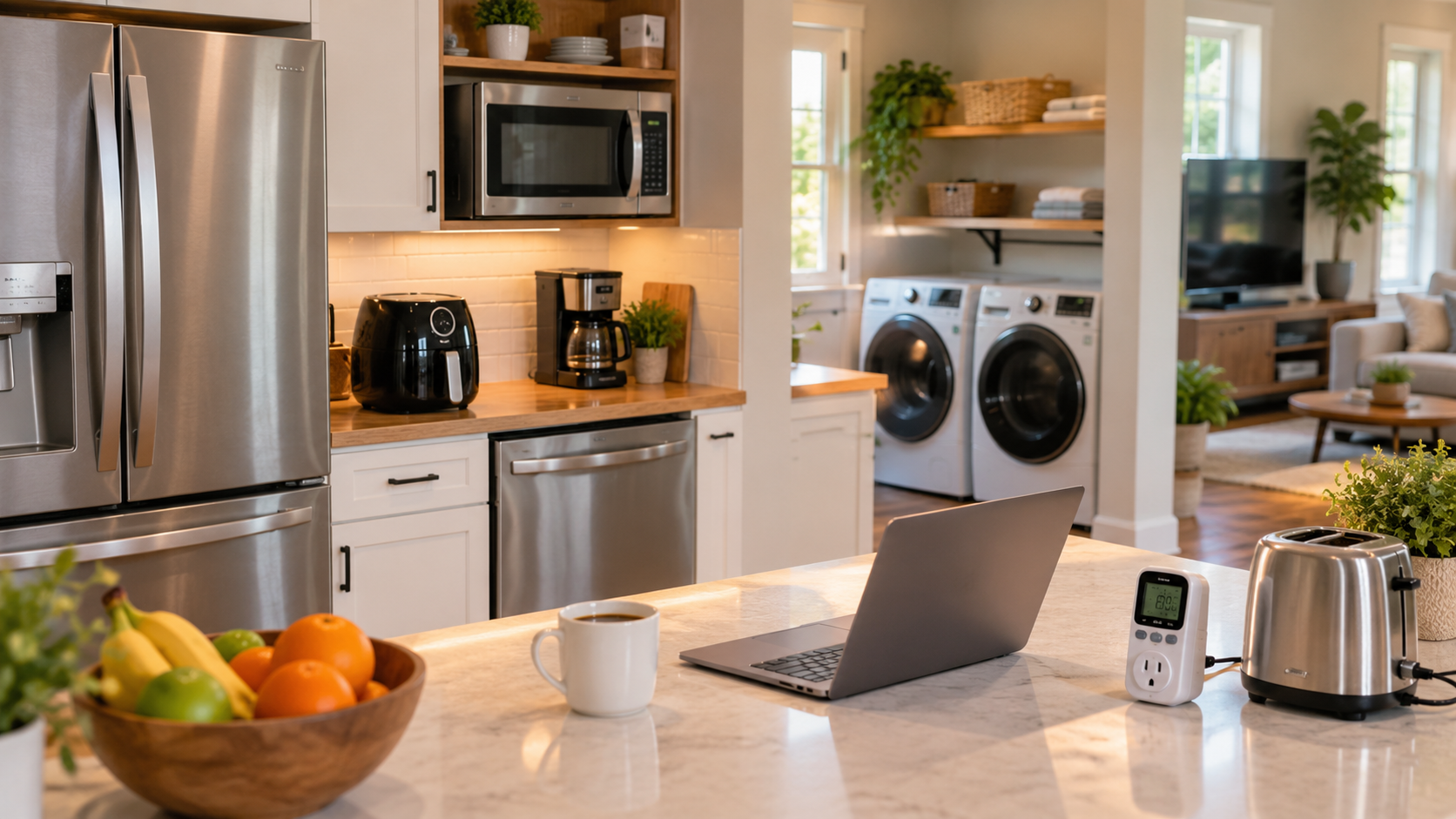
Household appliances use wildly different amounts of electricity. A phone charger may draw only a few watts, while an electric dryer, oven, water heater, or space heater can use thousands of watts when operating.
The important thing is that wattage alone does not tell you what an appliance costs to own. Run time matters just as much. A 1,500-watt hair dryer used for six minutes may cost less over a month than a 100-watt device that runs 24 hours a day.
This guide explains how appliance electricity use works, which household devices tend to consume the most power, and how to estimate what an appliance adds to your monthly bill.
How Appliance Electricity Use Is Measured
Most appliance labels list power in watts (W). Your utility bills electricity in kilowatt-hours (kWh).
To convert watts into electricity cost:
kWh = (Watts ÷ 1,000) × Hours Used
Then:
Cost = kWh × Electricity Rate
Using the latest national residential average from the U.S. Energy Information Administration—18.31¢ per kWh in July 2026—a 1,000-watt appliance running for one hour costs about 18 cents in electricity.
You can enter any wattage and usage pattern into our Electricity Cost Calculator.
Typical Electricity Use of Common Household Appliances
The figures below are planning estimates, not measurements of a specific product. Real appliances vary by model, efficiency, cycle, age, operating mode, and load.
| Appliance / Device | Typical Power | Approx. Cost per Hour* |
|---|---|---|
| LED light bulb | 10 W | $0.002 |
| Wi-Fi router | 12 W | $0.002 |
| Laptop computer | 60 W | $0.011 |
| LED TV | 100 W | $0.018 |
| Refrigerator compressor | ~150 W | $0.027 while running |
| Desktop computer | 250 W | $0.046 |
| Washing machine | 500 W | $0.092 |
| Vacuum cleaner | 1,200 W | $0.220 |
| Microwave | 1,200 W | $0.220 |
| Air fryer | 1,500 W | $0.275 |
| Space heater | 1,500 W | $0.275 |
| Electric cooktop burner | 1,800 W | $0.330 |
| Electric oven | 3,000 W | $0.549 |
| Central AC compressor/system example | 3,500 W | $0.641 while running |
| Electric clothes dryer | 5,000 W | $0.916 |
| Electric water heater element | 4,500 W | $0.824 while heating |
*Approximate cost at 18.31¢/kWh. Many appliances cycle on and off, so hourly cost while actively running is not the same as average hourly cost across an entire day.
For a much larger searchable list, use our 100 Household Appliances: Watts & Electricity Cost Database.
Which Appliances Use the Most Electricity?
The biggest electricity users are usually devices that either:
- Produce heat
- Move heat
- Run large motors or compressors
- Operate for many hours
That is why central air conditioning, electric resistance heating, water heating, clothes drying, cooking, pool equipment, hot tubs, and EV charging can have a much larger effect on a bill than small electronics.
Heating and Cooling
ENERGY STAR says nearly half of household energy use goes to heating and cooling. In an all-electric home, HVAC can dominate monthly electricity consumption during extreme weather.
If cooling is a major concern, use our Air Conditioner Running Cost Calculator.
Electric Water Heating
Electric tank water heaters often use heating elements around 4,500 watts. They do not run continuously, but every recovery cycle can draw a large amount of power. Household size, shower habits, set temperature, incoming water temperature, and tank efficiency all matter.
Electric Clothes Dryers
A full-size electric dryer can draw around 5,000 watts while heating. The monthly cost depends heavily on how many loads you run and how long each cycle lasts.
ENERGY STAR notes that certified dryers can save energy by using moisture sensors and automatic termination to stop the cycle when clothes are dry instead of over-drying them.
Cooking Appliances
Ovens, cooktops, air fryers, microwaves, kettles, and toaster ovens can draw significant power, but many operate only for short periods. A high-wattage appliance can still have a modest monthly cost if run time is low.
Which Appliances Use the Least Electricity?
Low-power electronics and LED lighting often use only a few watts to a few dozen watts. Examples include:
- Phone chargers
- Wi-Fi routers
- Streaming devices
- LED bulbs
- Smart speakers
- Small fans
- Laptop chargers
But a low-wattage device can still matter if it runs continuously. A 20-watt device running 24/7 uses about 14.4 kWh per month. At 18.31¢/kWh, that is about $2.64 monthly.
Why Refrigerators Are Different
A refrigerator may have a compressor rated around 100–200 watts, but the compressor cycles rather than running continuously. Door openings, room temperature, food load, age, temperature setting, gasket condition, and condenser cleanliness all affect how long it runs.
That means calculating refrigerator cost from nameplate wattage alone can substantially overestimate consumption if you assume 24 hours of full-power operation.
For refrigerators and other cycling equipment, an energy meter or the annual kWh estimate on the EnergyGuide label is usually more useful.
Why Electric Heaters Can Raise a Bill Quickly
Portable space heaters are a good example of why run time matters. A typical 1,500-watt heater uses 1.5 kWh every hour it is actively heating.
At 18.31¢/kWh:
- 2 hours/day: about $16.48 per month
- 4 hours/day: about $32.96 per month
- 8 hours/day: about $65.92 per month
Two heaters running eight hours a day would approximately double that electricity cost.
Do Appliances Use Electricity When Turned Off?
Some do. The Department of Energy calls this standby power: electricity consumed while a device is plugged in but not performing its primary function.
Standby loads can come from televisions, game consoles, speakers, computers, chargers, printers, coffee makers, smart devices, and other electronics with displays, clocks, networking, or remote-control functions.
Not every standby load is worth worrying about. A router, security system, refrigerator, or smart-home hub may need to remain powered. But for entertainment centers, office equipment, and rarely used electronics, switched power strips or smart plugs can make it easier to shut down groups of devices.
How Much Do ENERGY STAR Appliances Save?
ENERGY STAR certification is product-specific, so there is no single percentage that applies to every appliance. For example, ENERGY STAR says certified clothes washers use about 20% less energy and about 30% less water than regular washers.
The most useful approach is to compare the yellow EnergyGuide labels of similar models. That label shows estimated annual energy use and operating cost under standardized assumptions, making it easier to compare one refrigerator, washer, dryer, dishwasher, or other covered appliance with another.
How to Find the Real Electricity Use of Your Appliance
There are four practical approaches:
1. Read the Product Label
Look for watts, volts, amps, or annual kWh on the appliance or specification sheet.
2. Check the EnergyGuide Label
For many major appliances, the EnergyGuide label gives estimated annual energy consumption and operating cost.
3. Use a Plug-In Electricity Meter
For 120-volt plug-in appliances, a meter can measure actual watts and cumulative kWh over hours or days. This is especially useful for refrigerators, computers, entertainment systems, dehumidifiers, and other cycling loads.
4. Use Smart-Meter or Whole-Home Energy Data
Some utilities and home energy monitors provide hourly or near-real-time data that can help identify when major loads turn on.
How to Reduce Appliance Electricity Costs
The biggest opportunities usually come from changing either run time or efficiency.
- Run full laundry and dishwasher loads when practical
- Use cold-water wash cycles when appropriate
- Clean dryer lint filters after each load
- Avoid over-drying clothes
- Replace frequently used bulbs with LEDs
- Use sleep and energy-saving settings on electronics
- Shut down unnecessary standby loads
- Maintain refrigerator door seals and proper temperature settings
- Compare EnergyGuide labels when replacing major appliances
Our Home Energy Savings Checklist can help you turn these ideas into a simple plan.
What Electricity Rate Should You Use?
Your own utility bill is always best because electricity prices vary substantially by state, utility, rate plan, and time of use.
If you need a benchmark, visit our Electricity Prices by State page. The U.S. residential average was 18.31¢/kWh in July 2026, but some state averages were far above or below that figure.
The Bottom Line
The appliances that look “powerful” are not always the ones costing you the most. The real equation is wattage × run time × electricity price.
Start with the loads that heat, cool, pump, or run for many hours. Then measure or estimate the devices you use most frequently. Our 100-appliance database and Electricity Cost Calculator make it easy to compare them without guessing.