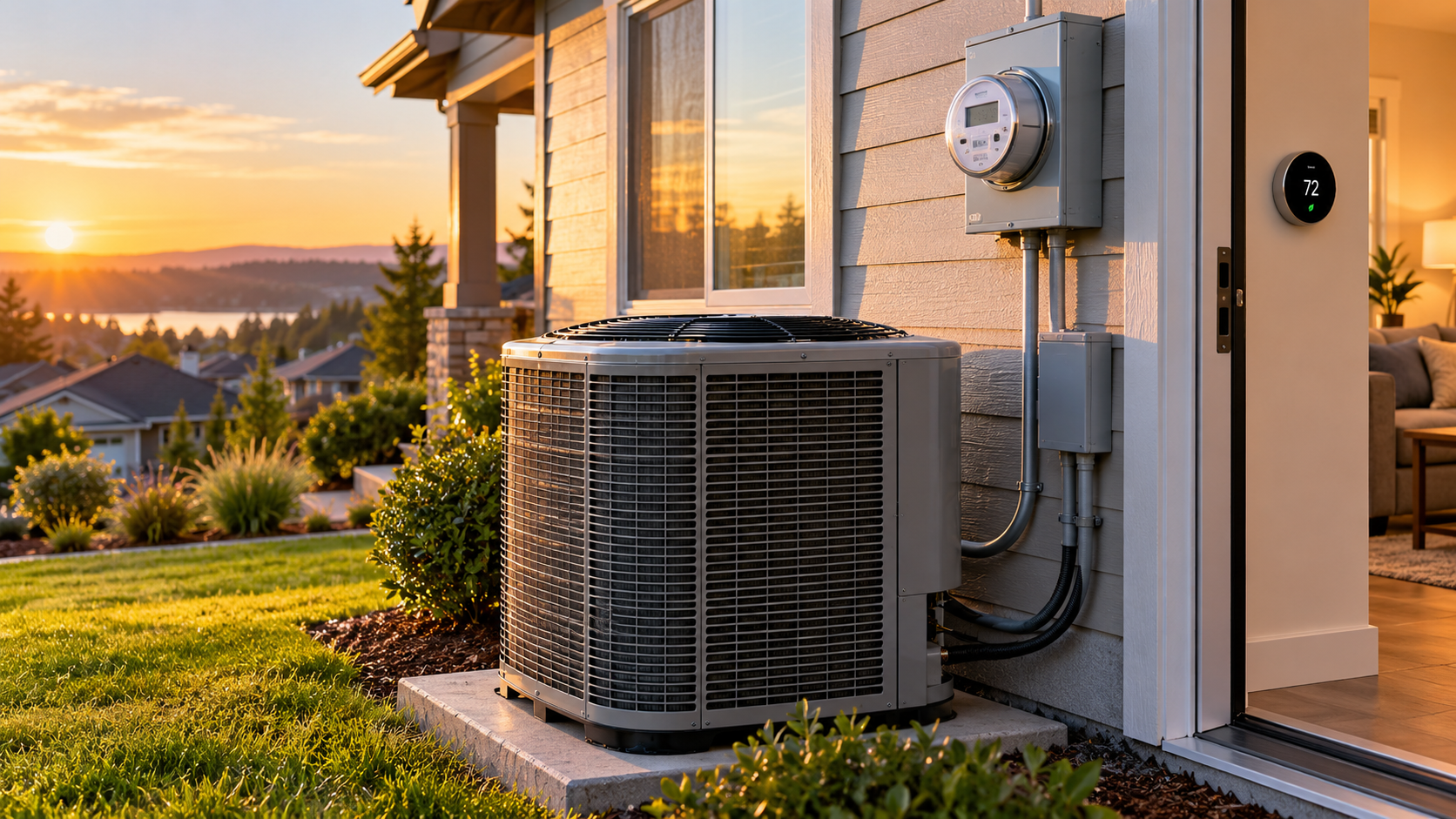
Air conditioning can be one of the largest electricity loads in a home, especially during long stretches of hot weather. But the cost to run an AC system varies enormously depending on the type of equipment, its power draw, how many hours it operates, your electricity rate, the weather, thermostat settings, insulation, and whether the system cycles or runs at variable speed.
A useful starting point is the latest U.S. residential electricity price: 18.31 cents per kilowatt-hour in July 2026, according to the U.S. Energy Information Administration. At that rate, a system that averages 1 kW of electrical input for eight hours a day would cost about $1.46 per day before accounting for cycling.
This guide explains how to estimate AC electricity use, what different systems may cost to operate, and which factors have the biggest effect on your cooling bill.
How Much Electricity Does an Air Conditioner Use?
There is no single wattage for “an air conditioner.” A small room unit may draw only a few hundred watts, while a large central system can draw several thousand watts when the compressor is running.
Typical planning estimates look roughly like this:
| AC Type | Approx. Input Power | Example Monthly Cost* |
|---|---|---|
| Small window AC (~5,000 BTU) | 500 W | About $14 |
| Window AC (~8,000 BTU) | 700 W | About $20 |
| Large window AC (~12,000 BTU) | 1,000 W | About $29 |
| Portable AC | 1,200 W | About $34 |
| Central AC (~2 ton) | 2,200 W | About $63 |
| Central AC (~3 ton) | 3,300 W | About $94 |
| Central AC (~4 ton) | 4,400 W | About $126 |
*Illustrative examples assume 8 hours available to run per day, a 65% compressor duty cycle, 30 days per month, and electricity at 18.31¢/kWh. Your actual equipment and weather may differ substantially.
For a household-specific estimate, use our Air Conditioner Running Cost Calculator.
The Formula for AC Running Cost
The basic calculation is:
Cost = (Watts ÷ 1,000) × Hours Running × Electricity Rate.
If an air conditioner draws 3,000 watts, runs an average of 5 hours per day, and electricity costs $0.1831 per kWh:
3 kW × 5 hours × $0.1831 = about $2.75 per day.
Over a 30-day month, that would be about $82.40.
The complication is that many systems do not draw full compressor power every minute they are switched on. Traditional systems cycle on and off. Variable-speed systems can ramp output up and down. That is why using actual runtime or measured electricity consumption gives a better estimate than simply multiplying nameplate wattage by 24 hours.
How Much Does It Cost to Run a Window Air Conditioner?
Window air conditioners are usually much smaller than whole-home central systems. ENERGY STAR’s room air conditioner sizing guidance starts at about 5,000 BTU for a 100–150 square foot room and increases as room size grows.
A 500-watt unit running effectively 5.2 hours per day—equivalent to an 8-hour window with a 65% duty cycle—would use about 2.6 kWh per day. At 18.31¢/kWh, that is roughly 48 cents per day, or about $14 per month.
A larger 1,000-watt window unit under the same assumptions would cost about twice as much.
How Much Does Central Air Conditioning Cost to Run?
Central AC systems usually have much larger compressors and also use a blower to move air through ductwork. A 3-ton system may draw roughly 3,000–4,000 watts while actively cooling, but actual input varies by model, efficiency, outdoor temperature, indoor load, and blower configuration.
Using a 3,300-watt example, an 8-hour cooling window and 65% duty cycle produces about 17.2 kWh of daily electricity use. At the current national average residential rate, that is roughly $3.14 per day or $94 per month.
In a hotter climate, during a heat wave, or in a poorly insulated home, runtime can be much higher. In mild weather, it may be much lower.
Why AC Costs Can Vary So Much
1. Outdoor Temperature and Humidity
The larger the difference between indoor and outdoor conditions, the harder the system has to work. Humidity also matters because air conditioners remove moisture as well as heat.
2. Thermostat Setting
Lower indoor temperatures generally increase cooling demand. ENERGY STAR recommends setting the thermostat as high as is comfortably practical and using schedules or smart controls to avoid unnecessary cooling when the home is empty.
3. Home Insulation and Air Leakage
A well-sealed, well-insulated home holds conditioned air better. The Department of Energy notes that reducing drafts and improving insulation can significantly reduce heating and cooling demand.
4. Equipment Efficiency
Two systems with the same cooling capacity can use different amounts of electricity. Higher-efficiency equipment is designed to deliver the same amount of cooling with less electrical input under standardized conditions.
5. Equipment Sizing
Bigger is not automatically better. ENERGY STAR warns that an oversized room air conditioner can cool a room too quickly without removing enough humidity, reducing comfort and wasting energy. Proper sizing matters for both comfort and efficiency.
6. Maintenance
Dirty filters, dirty coils, blocked airflow, and refrigerant issues can increase runtime. ENERGY STAR’s maintenance guidance notes that airflow problems can reduce system efficiency by up to 15%.
7. Duct Leakage
For central systems, leaky ducts can waste cooled air before it reaches living spaces. ENERGY STAR says sealing and insulating ducts can improve heating and cooling efficiency by as much as 20% in some homes.
Window AC vs. Portable AC vs. Central AC
A room air conditioner can be cheaper to operate when you only need to cool one room. Central AC is designed for whole-home comfort, so it uses more electricity but cools a much larger area.
Portable air conditioners can be convenient, but their real-world efficiency depends on the design and installation. Units that exhaust warm air through a hose can create pressure effects that pull warm outdoor air into the room, especially with single-hose designs.
Mini-split systems can be efficient because they avoid duct losses and can condition individual zones, but installation cost and system design matter.
How to Find Your AC’s Actual Wattage
For the most accurate estimate, look for:
- The equipment nameplate or specification sheet
- Rated electrical input in watts
- Voltage and amperage, if wattage is not listed
- Utility smart-meter data
- A whole-home energy monitor
- A plug-in power meter for small room units
If only volts and amps are listed, multiplying them gives a rough volt-amp figure, but AC equipment can have power-factor and startup characteristics that make this less precise than a true watt measurement.
How to Lower Air Conditioning Costs
The most practical steps usually include:
- Check and replace dirty filters
- Keep outdoor equipment clear of debris
- Use thermostat schedules that match occupancy
- Seal obvious air leaks
- Improve attic insulation where needed
- Seal accessible duct leaks
- Use blinds or exterior shading on high-sun windows
- Use ceiling or portable fans to improve comfort when appropriate
- Have poorly performing equipment inspected
For a broader list, use our Home Energy Savings Checklist.
What Electricity Rate Should You Use?
Your own utility bill is best. If you do not have it handy, our Electricity Prices by State page provides the latest state averages we track from EIA. In July 2026, the national residential average was 18.31¢/kWh, but state averages ranged from much lower to much higher levels.
The Bottom Line
The cost to run an air conditioner depends more on power draw, runtime, electricity price, and the condition of the home than on a single generic “cost per hour.” A small window unit may add only a modest amount to a summer bill, while a large central system running hard every day can become one of the household’s biggest electricity expenses.
Estimate your own numbers with the AC Running Cost Calculator, then focus on the factors that actually drive runtime: thermostat settings, weather, airflow, insulation, air sealing, duct leakage, and equipment condition.